BlueBird 7 (Block 2 #2)
New Glenn. Launch Complex 36A, Cape Canaveral SFS, FL, USA.
Launch Failure
AST SpaceMobile’s BlueBird 7 successfully launched on Blue Origin’s New Glenn rocket, but was placed into an unusable lower orbit and will be deorbited despite the booster landing successfully.
- Recovery
- GS1-SN002: Autonomous Spaceport Drone Ship, Jacklyn, successful
1 Landed
- Your Time
- UTC
- At the Pad

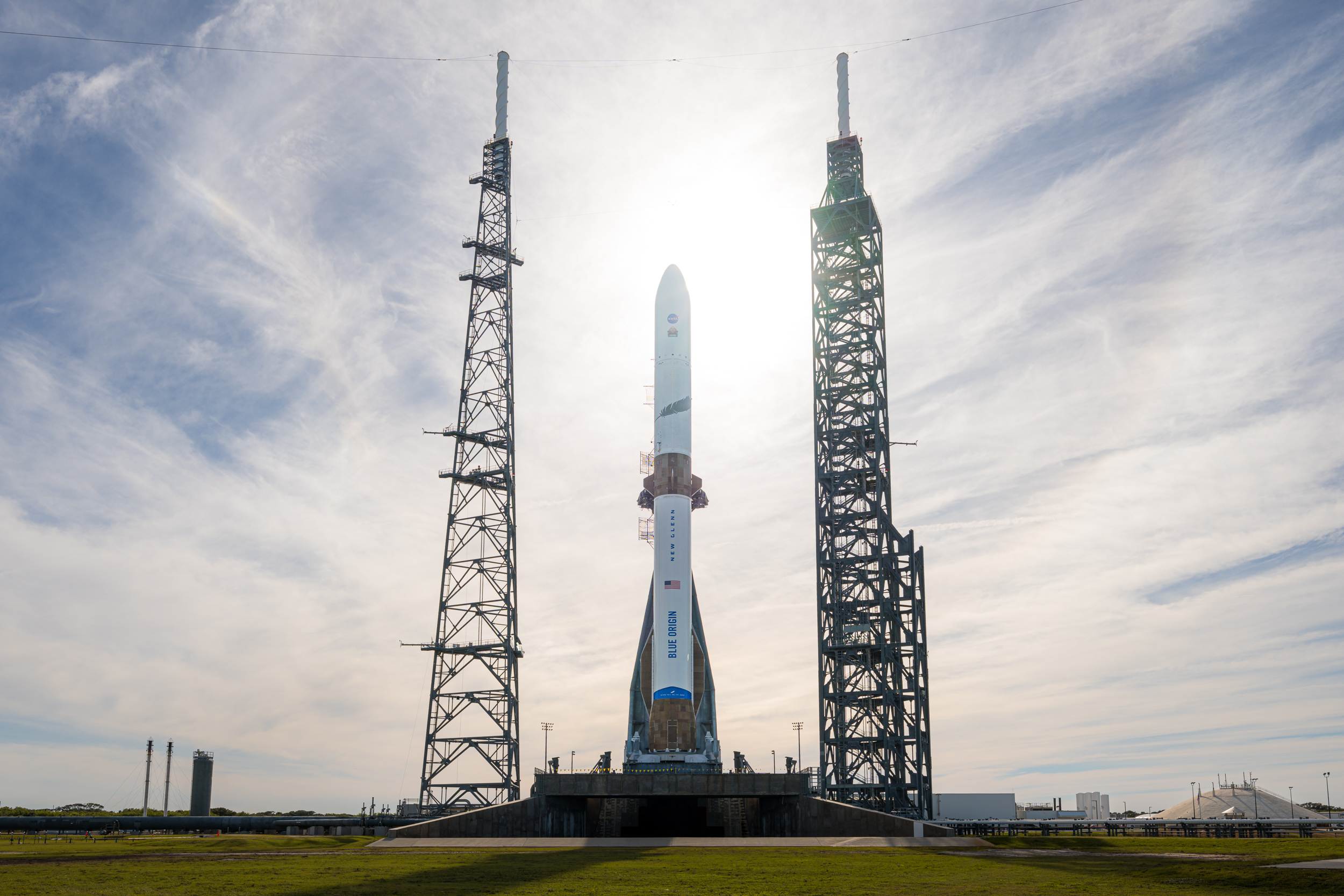
BlueBird 7 (Block 2 #2)
Blue Origin
Mission
Communications, Low Earth Orbit
AST SpaceMobile’s Block 2 BlueBird satellites are designed to deliver up to 10 times the bandwidth capacity of the BlueBird Block 1 satellites, required to achieve 24/7 continuous cellular broadband service coverage in the United States, with beams designed to support a capacity of up to 40 MHz, enabling peak data transmission speeds up to 120 Mbps, supporting voice, full data and video applications. The Block 2 BlueBirds, featuring as large as 2400 square foot communications arrays, will be the largest satellites ever commercially deployed in Low Earth orbit once launched. This launch will feature 1 satellite, BlueBird 7/BlueBird Block 2 FM2.
Countdown Sequence
Planned offsets from T-0; confirmations link to their sources
Sequence Ended · Failure
- T−04:30:00
Prop Load
Start of propelland loading
Not Confirmed
- T−00:45:00
Prop Load Complete
End of propellant loading
Not Confirmed
- T−00:30:00
Weather Check
Check of the weather conditions for launch
Not Confirmed
- T−00:17:00
Ready Poll
Polling ready ahead of terminal count
Not Confirmed
- T−00:04:00
Terminal Count
Start of the terminal countdown towards launch
Not Confirmed
- T−00:02:30
Tank Press
Fuel tanks are pressurized to flight levels
Not Confirmed
- T−00:01:30
Internal Power
Launch vehicle switches to internal power sources
Not Confirmed
- T−00:00:30
Water Deluge
Water deluge systems turn on
Not Confirmed
- T−00:00:30
Startup
The onboard computer takes control over the countdown and runs last checks
Not Confirmed
- T−00:00:06
Ignition
Start of the engine ignition sequence
Not Confirmed
- T+00:00:00
Liftoff
First upwards movement of the rocket
Not Confirmed
- T+00:01:36
Max-Q
Maximum dynamic pressure
Not Confirmed
- T+00:03:05
MECO
Cut-off of the main engine
Not Confirmed
- T+00:03:09
Stage 2 Separation
Separation of the second stage from the first
Not Confirmed
- T+00:03:16
SES-1
First start of the second engine
Not Confirmed
- T+00:03:42
Fairing Separation
Separation of the payload fairing
Not Confirmed
- T+00:07:06
Boosters Entry Burn Startup
Start of the boosters atmospheric entry burn
Not Confirmed
- T+00:07:37
Boosters Entry Burn Shutdown
End of the boosters atmospheric entry burn
Not Confirmed
- T+00:08:45
Boosters Landing Burn
Start of the boosters landing burn
Not Confirmed
- T+00:09:23
Boosters Landing
Landing of the boosters
Not Confirmed
- T+00:13:01
SECO-1
First cut-off of the second engine
Not Confirmed
- T+01:09:41
SES-2
Second start of the second engine
Not Confirmed
- T+01:10:49
SECO-2
Second cut-off of the second engine
Not Confirmed
- T+01:15:44
Payload Separation
Final deployment of the payload from the rocket
Not Confirmed
- T+02:49:12
SES-3
Third start of the second engine
Not Confirmed
- T+02:49:24
SECO-3
Third cut-off of the second engine
Not Confirmed
- T+03:05:08
Mission End
End of the launch vehicle's mission
Not Confirmed
Change Log
Detected changes and source updates
Launch failure.
Spacecraft separation; launch outcome pending.
Liftoff.
New T-0.
Hold at T-3:57.
Unofficial Webcast by Spaceflight Now has started
Updated launch weather, 90% GO.
GO for launch.
NET April 19, TBC.
Delayed to NET April 18, TBC.
Delayed to NET April 17.
NET April 16.
NET April 14.
NET April 12 per air space closure notices.
NET April 10.
NET March.
Launch moved to New Glenn, NET late February.
NET January.
NET Q1 2026.
Added launch.